


What Is a Robotic Welding Machine? Features and Benefits
Robotic welding machines are becoming an essential solution for many mechanical and manufacturing businesses. This technology helps optimize processing speed, improve welding accuracy, and create a safer working environment. At the same time, automated systems support companies in reducing long-term operating costs.
.jpg)
What Is a Welding Robot?
In the modern mechanical engineering industry, the demand for improving product quality and optimizing operating costs is becoming increasingly important. Manufacturers not only need to ensure production progress but also maintain consistent weld quality over long periods. This is why many factories are choosing robotic welding machines to replace traditional manual welding methods.
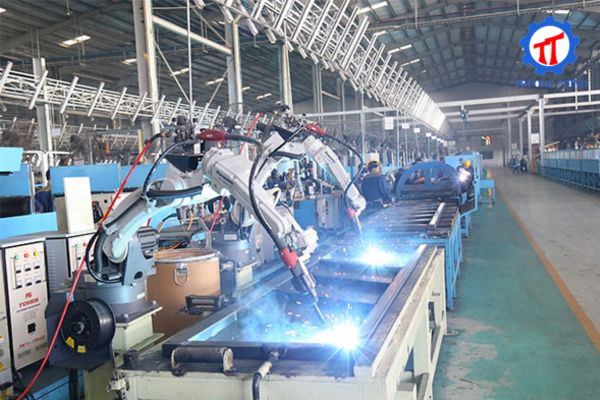
A welding robot is a mechanical robotic arm integrated with a welding power source, control system, and automated programming software. The machine can move flexibly within a multi-axis space to perform complex welding paths with high precision. Unlike fixed automated welding systems that operate in only one direction, welding robots can work on a variety of components and structures.
This technology is widely used in automobile manufacturing plants, steel structure fabrication, mechanical engineering workshops, industrial equipment production, and mass-production assembly lines. Thanks to their ability to operate continuously, robots help businesses maintain stable productivity over long periods.
Key Components of an Automated Welding System
.jpg)
An automated welding line typically consists of multiple devices working together to ensure stable and safe operations. All components are closely connected to maintain the quality of finished products.
Robotic Arm and Controller
This is the central part of the entire system. The robotic arm usually has six or more axes of movement, allowing it to access difficult welding positions. The controller is responsible for data processing, program storage, and coordinating all robot movements.
With high repeatability accuracy, robotic welding machines create consistent welds even during large-scale production. This is a major advantage compared to manual welding methods.
Welding Equipment and End-of-Arm Tooling
The welding power source, wire feeder, welding torch, and cooling system are indispensable components. These devices are specifically designed to synchronize with the robot.
Depending on production requirements, businesses can choose MIG/MAG welding, TIG welding, spot welding, or laser welding technologies. Each method is suitable for different materials and technical demands.
Supporting Peripheral Equipment of Robotic Welding Machines
In addition to the main robot, the system also includes fixtures, rotary positioners, torch cleaning stations, and automated material feeding systems. These devices help optimize welding positions and maintain arc stability.
Some factories also integrate safety systems such as warning alarms, door sensors, and emergency stop buttons to protect operators during production.
See more:
Mechanical Processing Services in Hai Phong
Outstanding Benefits of Investing in Robotic Welding Machines
.jpg)
In today’s highly competitive market, mechanical engineering companies need solutions that improve production efficiency while maintaining stable product quality. Welding automation has become one of the top priorities for modern factories.
Improved Weld Quality
Robots can maintain stable speed and welding paths throughout the entire process. This significantly reduces defects such as undercutting, incomplete penetration, or dimensional inconsistencies.
In addition, automated systems reduce dependence on worker skill levels, ensuring consistent product quality across production batches.
Increased Production Productivity
Unlike manual labor, robots can operate continuously at high intensity. Downtime is mainly required for maintenance or changing workpieces.
With continuous operation capabilities, robotic welding machines help businesses shorten production time and increase output during each working shift. This is a significant advantage for mass-production factories.
Better Working Environment
Welding processes often generate fumes, UV radiation, and high temperatures that can negatively affect workers’ health. By using robots, employees are less exposed to hazardous working conditions.
Besides improving safety, companies can also reduce the pressure of recruiting highly skilled welders in a market facing labor shortages.
Important Considerations Before Implementing Welding Robots
Although robotic welding systems provide many advantages, the investment must be carefully planned. The initial cost for robotic welding machines, fixtures, software, and safety systems can be relatively high.
Businesses also need standardized production processes to ensure workpiece accuracy and repeatable positioning. If products change frequently or production volume is too low, the investment efficiency may not meet expectations.
In addition, operators should be trained in programming, maintenance, and basic troubleshooting. This helps ensure stable system performance and minimizes production downtime.
Conclusion
In the era of smart manufacturing, robotic welding machines are becoming an essential solution for businesses seeking to improve quality and optimize operating costs. With stable, precise, and safe performance, this technology is suitable for many modern mechanical engineering industries. Investing in the right robotic welding system will create a strong foundation for long-term competitiveness in the market.
Truong Thinh Mechanical Engineering Information
Hotline:
Mr. Hung: 0936.988.978
Mrs. Tam: 0904.488.455
Tel: 0225.627.79.97
Factory Address: Area C, No. 57 Km5, Lam San, So Dau Ward, Hong Bang District, Hai Phong, Vietnam
Website: Truong Thinh Mechanical Engineering